The Tacoma Trailhunter takes Toyota’s already capable and iconic mid-size pickup an extra step up on the ladder of off-road capability. Though, it might not be in the way that you’d think. Instead of targeting the market of high-speed handling and extreme suspension travel to handle leaving the ground like the Ford Raptor lineup, the Trailhunter takes aim at a slower and more sure-footed off-road activity: overlanding.
If you read the word “overlanding” and immediately envisioned 4Runners, Land Cruisers, Jeeps, and Land Rovers with roof-mounted tents, light bars, and not a spec of dirt on them as they sit in a Starbucks parking lot, I’ve no reason to blame you. Like many off-road enthusiasts, there’s much more talk than action in significant portions of the overlanding community. That said, coming from the rally-inspired world of off-road fun, I was pleasantly surprised by how much I enjoyed my time in the Trailhunter when presented with steep inclines, break-overs, and rocks. Moreover, I was truly impressed with the Trailhunter’s capability. So, thank you, Toyota, for loaning me this truck for a week and enlightening me. To the overlanding enthusiasts: I get it now. I’m not retracting my statement at the beginning of the paragraph, though.
Well-equipped and Ready to Go Anywhere

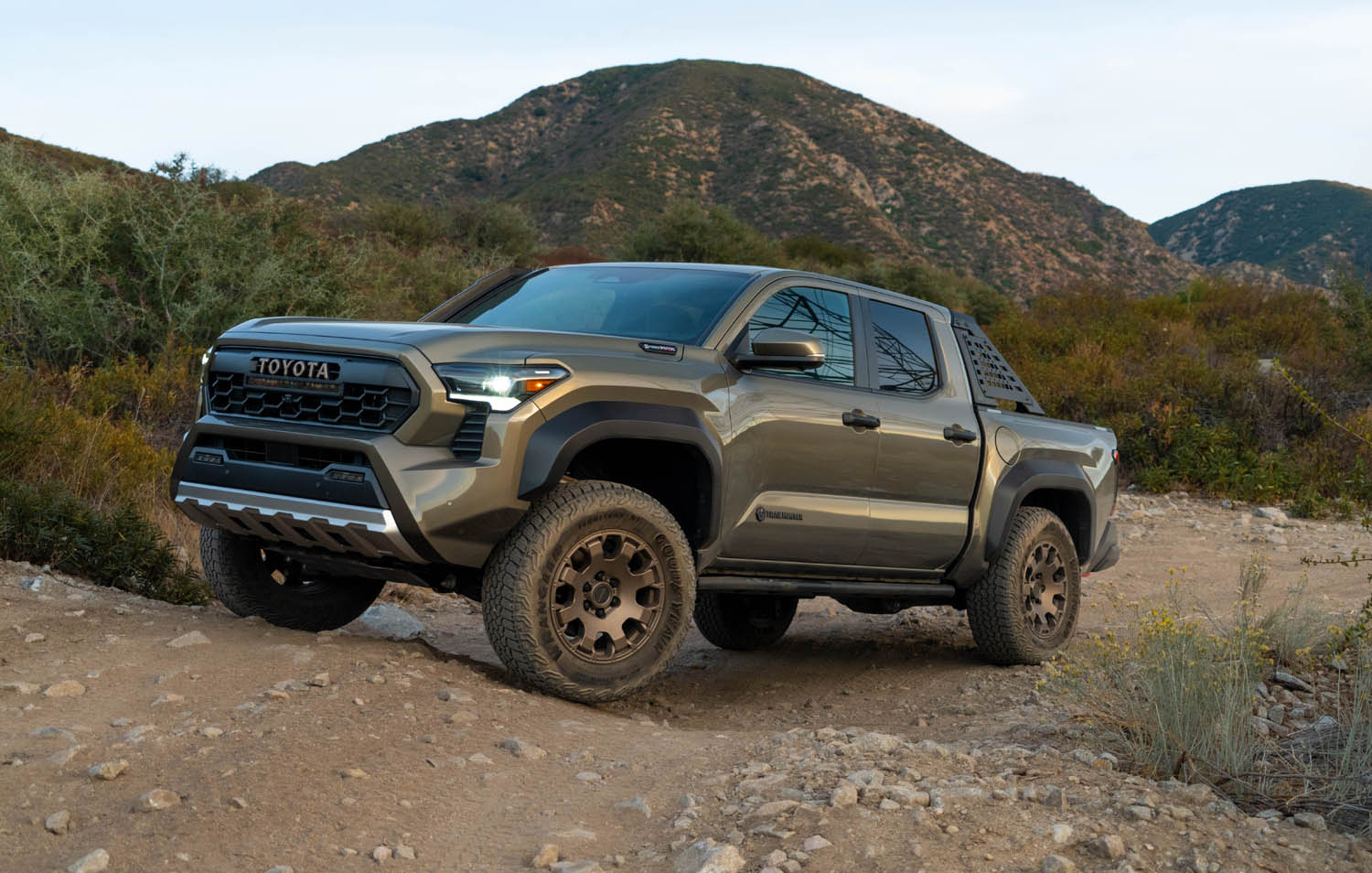
In addition to the standard 2.4-liter turbocharged i-FORCE MAX hybrid drivetrain you find in the rest of the Tacoma lineup, the Trailhunter has a powerful package of features that optimize it to take on obstacles on the trail. You’ll find Old Man Emu 2.5-inch forged monotube shocks on all four corners. They use remote reservoirs and are position-sensitive. Moreover, if you aren’t familiar, Old Man Emu suspension is purpose-designed for this type of off-roading. Its off-road preparedness goes far beyond suspension, too.
As the photos show, the Trailhunter wears 33-inch rugged-terrain-ready tires and has a snorkel running up the passenger-side A-pillar. We think the snorkel is beyond rad, but some folks aren’t too fond of it because of the “excessive” intake noise. More on that later. Beyond that, the Trailhunter has a high-clearance front bumper, a steel ARB rear bumper with tow hooks, an onboard air compressor, a built-in light bar, rock rails, and a high-clearance exhaust system.
The modular bed system, roof-top cargo rack, remarkable bed lighting, and a 2,400-watt 110-volt outlet are all just the cherry on top. Ultimately, I’m left with no doubts that the Tacoma Trailhunter is the ultimate overlanding companion. In fact, given the choice, I don’t think there’s a different bone-stock truck I’d even consider being stranded in the mountains with for days on end.
Tacoma Trailhunter Driving Experience: Off the Beaten Path

Ultimately, it makes the most sense to start where Toyota engineers designed the Tacoma Trailhunter to be: off-road. I spent some time with the trail hunter at the iconic Cleghorn trail in southern California and got the chance to put it through its paces. Sure-footed is an understatement when it comes to this truck. Yes, it’s an off-road-optimized Toyota Tacoma, so it’s not shocking that it excels on the trails. However, through hectic break-overs, powdered-sugar-soft dirt, loose gravel on steep hills, and steep rock faces, the Trailhunter showed no signs of struggling. In four low, you can lock the Trailhunter’s rear differential for some added grip. However, I didn’t run into one instance where it was necessary.
Of course, having the option to lock the diff does add some peace of mind. However, I would love to have seen it usable in 4WD high and 2WD modes, too. That aside, the Trailhunter also has an electronically disconnectable sway bar to open up more suspension articulation for situations with substantial elevation differences.
Finally, one of the highlights of the Trailhunter is Toyota’s Multi-terrain Selection (MTS) system, which allows you to specify the type of terrain the truck is up against. Mud, sand, rock, and auto are the given options. I opted to trust Toyota’s engineering department and elected to leave it in auto. MTS also offers crawl control Downhill Assist Control (DAC), which is effectively a semi-automated cruise control to maintain your speed and composure downhill. In addition, MTS also allows the use of Toyota’s iconic crawl control, which can help you get out of a challenging situation.
Daily Driving this Mountain Monster

Beyond the scope of the rolling hills, steep mountain trails, and windshield-deep puddles, the Trailhunter offers a perfectly acceptable level of daily comfort. That is, aside from that pesky snorkel.
I call it “pesky” with a healthy dose of sarcasm. There have been some complaints of its “excessive” noise. However, it’s borderline unnoticeable with the windows up and the radio on. That said, it is pretty loud if you’ve got the passenger window down. If you’re a fan of turbos like we are, you’ll probably find yourself grinning ear to ear at the heavenly turbo flutter when you lift off the accelerator. It’s a blast. I found myself driving with the window cracked just for the sake of hearing it.


Inside, the Trailhunter is plenty comfortable with all the modern tech and amenities you’d expect. Heated and ventilated seats, an infotainment system that is responsive and cooperative, and, my personal favorite, a removable JBL Bluetooth speaker that, when installed in the dash, acts as a part of the truck’s sound system. That’s a nice touch. The best touch, though, is the abundance of high-wattage USB-C ports in both the front and back of the cab, as well as in the bed with the air compressor. Thank you, Toyota, for hopping aboard the movement to universalize USB-C.
Final Verdict: It’s a Grand Slam

The only detriment I really found in the Tacoma Trailhunter is its lackluster fuel economy performance. Even though it’s a hybrid, spinning those 33-inch tires puts quite a dent in the numbers. The EPA ratings of 22 mpg city and 24 mpg highway were quite alluring. However, in the end, I only saw an average of 17.2 mpg according to the truck’s trip computer after mixing highway driving, city driving, and off-roading. Furthermore, during a small road trip spanning about 150 miles at an average speed of around 75 miles per hour, I only managed to squeeze 21 mpg out of it. That’s a bit of a bummer, but certainly not unexpected.
I feel I should mention the price tag here, too. Though, I don’t feel like it’s fair to mark it down as a negative, necessarily. With its starting price tag of $62,735, it’s certainly up there. It’s the second most expensive Tacoma trim level, falling only behind the TRD Pro. That said, it should come as no surprise that such a feature-laden truck comes with a hefty price tag. So, I don’t think it’s fair to complain. My one note here is that, for the similarity in price, I’d opt for the Ranger Raptor. That is, of course, a victim of circumstance courtesy of my desire to go fast and sideways through the dirt.
Overall, the Trailhunter is a slam dunk. When it’s in its element, there’s virtually nothing that can stop it. Rest assured, if you’re on the fence about buying one and want to be sure that it’s as capable as you think it is in your head. It most definitely is.